By Alcilene Farias (CFC-GS/UFPA)
International climate finance has established itself as a key tool for supporting developing countries in implementing policies and projects aimed at mitigating climate change. These resources, which come mainly from multilateral development banks and international cooperation mechanisms, seek to complement domestic efforts and scale up investments in line with global climate commitments.
What is the Brazil Climate Finance Project?
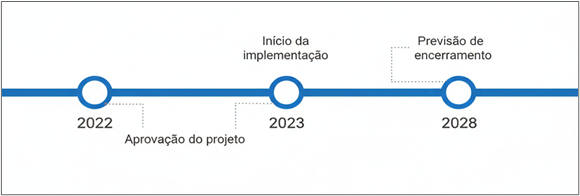
The Brazil Climate Finance Project is an initiative launched by the World Bank, in partnership with Banco do Brasil, to promote climate finance in Brazil. The project was approved on December 22, 2022, and seeks to drive financial solutions aimed at mitigating climate change and strengthening the Brazilian private sector’s ability to access carbon credit markets.
The project, officially identified as (P178888), has as its main objective to expand financing for sustainability and climate change mitigation in Brazil, while strengthening access to high-quality carbon credit markets. In other words, the project creates financial mechanisms that offer bank credit conditional on climate targets; help companies measure, reduce, and trade emissions reductions; facilitate access to carbon markets; and mobilize private capital for mitigation actions.
Figure 1 – Brazil Climate Finance Project timeline (2022–2028)
Source: Banco Mundial
How does the financing work?
In 2022, the World Bank approved US$500 million through its lending arm for middle-income countries (IBRD). These funds will be used by Banco do Brasil, which, in this case, acts as a financial intermediary. With the support of the World Bank, Banco do Brasil will be responsible for directing the funds to specific, predefined subprojects focused on climate mitigation, through the structuring of credit lines linked to climate goals. In this sense, the approved funds are not allocated directly to individual companies or projects, but are transferred to Banco do Brasil, which organizes and offers loans to companies that make environmental commitments, such as reducing greenhouse gas emissions.
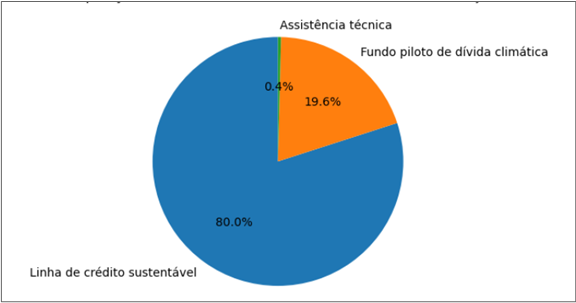
Most of the money goes to a $400 million credit line linked to sustainability. This means that companies can access loans on the condition that they adopt clear emission reduction targets and other environmental practices. This is the main instrument of the project and where almost all the financing is concentrated.
In addition, the project has a $98 million climate debt pilot fund. This fund serves to attract private investors and increase the volume of resources available for climate mitigation projects, functioning as a complement to the main credit line.
There is also a smaller portion of funds, approximately US$2 million, earmarked for technical assistance. This money is not used directly for loans, but for technical and institutional support, such as developing methodologies, monitoring environmental goals, and preparing companies to access climate finance.
Figure 2 – Composition of Brazil Climate Finance Project funding (%)
Source: Prepared internally based on public information from the World Bank (Project P178888)
The project was designed with clear climate mitigation impact goals. These include:
- Reducing up to 90 million tons of CO₂ equivalent by 2030, representing approximately 4.5% of the reductions needed for Brazil to meet its climate goals under the Paris Agreement.
- Mobilization of up to US$ 1.4 billion in private capital to support the climate transition of Brazilian companies.
Therefore, as mentioned above, Banco do Brasil, one of the country’s leading financial institutions, will be responsible for implementing the project in the domestic market. In this sense, the partnership provides for the bank to act as a financial intermediary, offering credit lines and technical assistance to interested companies.
How is the project progressing?
The project is still in the implementation phase, with progress considered satisfactory so far. According to the initial project documents, the operationalization of the credit lines depended on the project’s approval by the competent national authorities, including the Federal Senate, as provided for in the institutional design of the financing, with the initiative expected to end on April 30, 2028.
The Brazil Climate Finance Project is part of a broader effort to strengthen green finance in the country, which also includes: the creation of large-scale climate investment platforms, such as the Brazil Climate & Ecological Transformation Investment Platform; and the involvement of multilateral and national institutions to scale up investments in clean energy, forest restoration, and resilient infrastructure.
According to analyses by the Climate Policy Initiative (CPI), the project represents a significant portion of credits linked to sustainable practices and land use in Brazil, with a significant impact on supporting carbon markets and private investments.
References
BRASIL. Ministério da Fazenda. Brazil Climate and Ecological Transformation Investment Platform launches to help deliver Brazil’s ambitious development and climate goals. Brasília: Ministério da Fazenda, 23 out. 2024. Atualizado em: 09 out. 2025. Disponível em: https://www.gov.br/fazenda/pt-br/acesso-a-informacao/acoes-e-programas/transformacao-ecologica/bip/brazil-climate-and-ecological-transformation-investment-platform-launches-to-help-deliver-brazil2019s-ambitious-development-and-climate-goals. Acesso em: 6 jan. 2026.
CLIMATE POLICY INITIATIVE. International development and cooperation landscape of climate finance for land use in Brazil, 2021–2023. London: Climate Policy Initiative, 2024. Disponível em: https://www.climatepolicyinitiative.org/international-development-and-cooperation-landscape-of-climate-finance-for-land-use-in-brazil-2021-2023/. Acesso em: 6 jan. 2026.
WORLD BANK. Brazil Climate Finance Project (P178888). Washington, DC: World Bank Group, s.d. Disponível em: https://projects.worldbank.org/pt/projects-operations/project-detail/P178888. Acesso em: 5 jan. 2026.
WORLD BANK. World Bank and Banco do Brasil develop climate finance solution. Washington, DC: World Bank Group, 22 dez. 2022. Disponível em: https://www.worldbank.org/en/news/press-release/2022/12/22/banco-mundial-banco-do-brasil-desenvolvem-solucao-financiamento-climatico. Acesso em: 5 jan. 2026.
WORLD BANK. Brazil Climate Finance Project (P178888): Project Information Document (PID). Washington, DC: World Bank Group, 7 out. 2022. Disponível em: https://ewsdata.rightsindevelopment.org/files/documents/88/WB-P178888_FKRpg0y.pdf. Acesso em: 6 jan. 2026.
WORLD BANK. Appraisal Environmental and Social Review Summary – Brazil Climate Finance Project (P178888). Washington, DC: World Bank Group, 29 nov. 2022. Disponível em: https://ewsdata.rightsindevelopment.org/files/documents/88/WB-P178888_AzHik44.pdf. Acesso em: 6 jan. 2026.
WORLD BANK. Brazil Climate Finance Project (P178888) Implementation Completion and Results Report. Washington, DC: World Bank Group, 2023. Disponível em: https://documents1.worldbank.org/curated/en/099040223192539108/pdf/P178888058c5720ac0b4280b631f31918a4.pdf. Acesso em: 6 jan. 2026.