By Alcilene Farias (CFC-GS/UFPA)
What is the Green Climate Fund?
The Green Climate Fund (GCF) is an international climate finance fund established under the United Nations Framework Convention on Climate Change (UNFCCC) with the aim of financing actions to mitigate greenhouse gas emissions and adapt to the impacts of climate change, particularly in developing countries (UNEP, 2025).
The fund was politically established in 2010 during the Cancún Agreements, and its institutional structure was formalized in 2011. Following this, it underwent a period of institutional development and resource mobilization between 2014 and 2019, during which it defined its operational structure and launched its first projects. Since then, it has established itself as one of the main instruments of international climate finance (2020–2023) (Green Climate Fund, 2023).
Throughout the period from 2020 to 2023, the GCF underwent a significant expansion of its operations. During this time, the fund expanded its portfolio to more than 200 projects, with approximately $12 billion in own funding and more than $45 billion mobilized through co-financing, reaching 129 countries (Green Climate Fund, 2023).
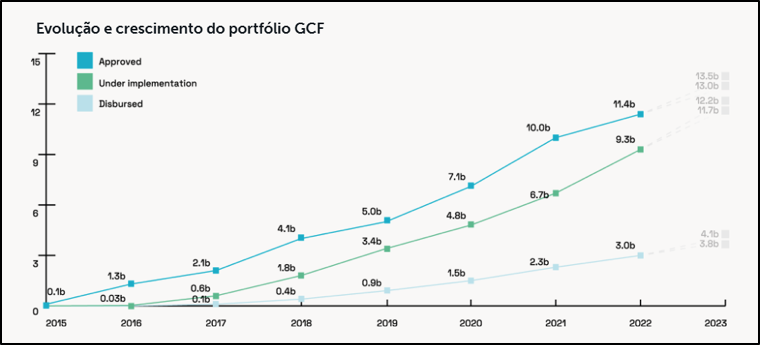
Figure 1 shows the evolution of funding between 2015 and 2023, distinguishing between approved amounts, amounts currently being implemented, and amounts actually disbursed. There has been a significant increase in the volume of funds over the period, particularly since 2020. At the same time, the difference between approved amounts and those actually disbursed shows that project implementation does not occur immediately. Part of the funding remained in the implementation phase or had not yet been disbursed, indicating that projects take time to move from the drawing board to execution (Green Climate Fund, 2023, p. 17).
Graph 1 – Evolution and growth of the GCF portfolio
Source: Green Climate Fund (2023), GCF-1 Progress Report. Available at: https://www.greenclimate.fund/gcf-1-progress-report
This model was further developed in subsequent phases, specifically GCF-2 (2024–2027), which aims to further expand the volume of resources, strengthen support for the most vulnerable countries, and increase the impact of funded actions (Green Climate Fund, 2026).
Objectives and Areas of Action
The GCF operates with two central objectives: mitigation and adaptation. In the field of mitigation, it seeks to reduce greenhouse gas emissions through initiatives such as renewable energy, sustainable transportation, forest conservation, and energy efficiency. In the area of adaptation, the focus is on strengthening countries’ capacity to respond to the impacts of climate change, including food and water security, resilient infrastructure, ecosystem protection, and support for vulnerable populations.
The fund also seeks to maintain a balance between the resources allocated to these two areas.
Operation and access to resources
The GCF is based on an institutional governance structure led by a Board composed of representatives from developed and developing countries, which ensures a balanced management model. It has its own legal personality and acts independently, although it is linked to the UNFCCC’s financial mechanism and operates under the guidance of the Conference of the Parties (COP), to which it reports and follows strategic guidelines.
Access to GCF resources is facilitated through a specific institutional framework. Each country designates a national authority, known as the National Designated Authority (NDA), which is responsible for coordinating relations with the fund and ensuring that projects align with national strategies. Projects are submitted by accredited entities, which are authorized to access the resources, while implementation is carried out by executing entities. This model reinforces the country-driven approach, ensuring that financing is aligned with national priorities (Green Climate Fund, 2011).
Financial instruments and sources of funding
Regarding financial instruments, the GCF uses a diverse mix that includes grants, concessional loans, guarantees, equity investments, and co-financing mechanisms with multilateral banks and other institutions. This diversity allows the fund not only to finance projects directly but also to act as a catalyst for additional resources, mobilizing public and private investments on a larger scale and expanding the total volume of climate finance available to developing countries (Green Climate Fund, 2011).
GCF resources come primarily from developed countries, which make financial commitments within the framework of international climate governance to support mitigation and adaptation actions in developing countries. In addition to government contributions, the fund may also receive contributions from various sources, including multilateral banks, financial institutions, the private sector, and foundations, which expands its capacity to mobilize resources (Green Climate Fund, 2011).
Types of Eligible Projects
Projects funded by the GCF cover various strategic areas, such as:
- Clean energy;
- Resilient agriculture;
- Adaptation to droughts and floods;
- Forest conservation;
- Sustainable cities;
- Coastal protection; and
- Climate early warning systems.
These initiatives must generate measurable climate impact and social benefits.
Limitations on Access to Climate Finance
Despite its relevance, access to these resources faces significant limitations. In a study conducted by the World Resources Institute titled Improving Access to the Green Climate Fund: How the Fund Can Better Support Developing Country Institutions, Caldwell and Larsen (2021) show that, although the fund was created to expand developing countries’ direct access to climate finance, this objective still faces significant obstacles. According to the authors, the complexity of the processes, the high costs of project development, and the limitations of support mechanisms make it difficult for many institutions to translate accreditation into effective access to resources, which contributes to the concentration of funding in international entities.
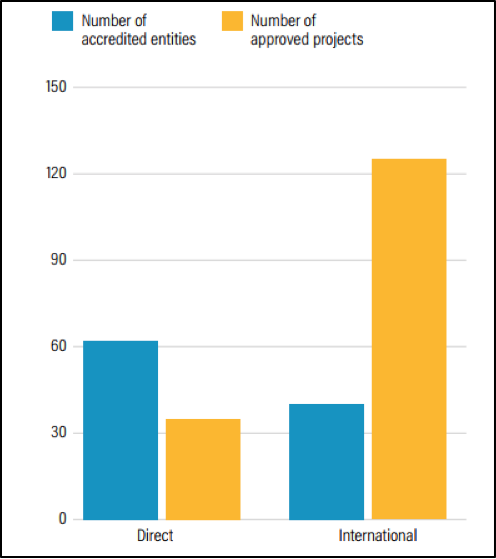
Figure 2 reinforces this analysis by comparing the number of accredited institutions with the number of approved projects. The data reveal a certain imbalance in access to climate finance; although there is a significant number of accredited national institutions, the majority of approved projects are concentrated among international entities.
Graph 2 – Direct and International Entities: Number of Entities versus Number of Projects Approved
Source: Caldwell e Larsen (2021), World Resources Institute. Available at: https://www.wri.org/research/improving-access-green-climate-fund-how-fund-can-better-support-developing-country
Despite the expansion observed in resource mobilization under GCF-1 and GCF-2, these challenges persist. The Fund itself recognizes the need to broaden the participation of national entities and strengthen their institutional capacities. Thus, although there have been significant advances in terms of funding volume and global reach, structural limitations remain in the functioning of international climate finance (Green Climate Fund, 2023).
Considerations
The Green Climate Fund has established itself as one of the main instruments of global climate finance, playing a key role in supporting developing countries in their transition to more sustainable and resilient economies. Despite challenges in accessing resources, institutional capacities, and the functioning of its mechanisms, the fund remains essential for enabling climate action on a global scale and for strengthening international cooperation in addressing climate change.
You can read more articles about climate finance on our blog and access financing data on our tracker. Check it out!
REFERENCES
CALDWELL, Molly; LARSEN, Gaia. Improving access to the Green Climate Fund: how the fund can better support developing country institutions. Washington, DC: World Resources Institute, 2021. Disponível em: https://www.wri.org/research/improving-access-green-climate-fund-how-fund-can-better-support-developing-country. Acesso em: 6 abr. 2026.
GREEN CLIMATE FUND. GCF-1 progress report: GCF’s first replenishment period 2020–2023. Incheon: Green Climate Fund, 2023. Disponível em: https://www.greenclimate.fund/gcf-1-progress-report. Acesso em: 6 abr. 2026.
GREEN CLIMATE FUND. GCF-2. Disponível em: https://www.greenclimate.fund/gcf-2. Acesso em: 6 abr. 2026.
GREEN CLIMATE FUND. Governing instrument for the Green Climate Fund. Songdo, Incheon: Green Climate Fund, 2011. Disponível em: Governing Instrument Green Climate Fund. Acesso em: 6 abr. 2026.
GREEN CLIMATE FUND. Green Climate Fund. Disponível em: https://www.greenclimate.fund/. Acesso em: 6 abr. 2026.
UNITED NATIONS ENVIRONMENT PROGRAMME (UNEP). Green Climate Fund. Disponível em: https://www.unep.org/about-un-environment/funding-and-partnerships/green-climate-fund. Acesso em: 9 abr. 2026.