By Alcilene Farias (CFC-GS/UFPA)
The climate crisis and poverty are closely linked, as changes in climate tend to widen social and economic inequalities. In general, those who have contributed least to the problem suffer most from its effects. Although developed countries have historically been responsible for most greenhouse gas (GHG) emissions, it is the poorest populations, especially in the Global South, who face the most severe consequences. The impacts of climate change, such as prolonged droughts, floods, sea level rise, and biodiversity loss, disproportionately affect vulnerable populations, reducing incomes, compromising food security, and increasing the incidence of disease.
The global scale of these events is very concerning. The Centre for Research on the Epidemiology of Disasters (CRED, 2025), which maintains the International Disaster Database (EM-DAT), recorded 393 disasters related to natural hazards, which caused 16,753 deaths, affected 167.2 million people, and resulted in economic losses of US$241.95 billion. Vulnerability is particularly evident in local contexts, such as in Brazil, where floods and landslides in early May in the Rio Grande do Sul region caused an estimated US$7 billion in damage (CRED, 2025).
According to Bruna and Pisani (2010), poor populations are often the most affected, precisely because they live in more precarious situations, in high-risk areas such as hillsides, riverbanks, suburbs without infrastructure, etc., and have less access to public services such as sanitation, health, and transportation, with few financial resources to recover after a disaster. Poverty acts as a factor that multiplies risks and their adverse effects (Bruna; Pisani, 2010).
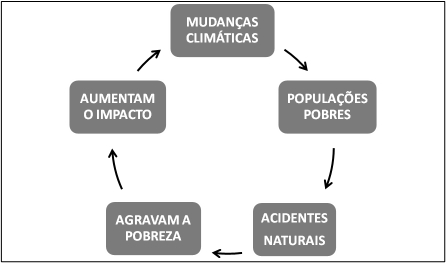
Figure 1 illustrates the cycle of vulnerability between climate change and poverty, as described by Bruna and Pisani (2010). The cycle begins with climate change, which leads to natural disasters (such as floods and landslides). These disasters impact poor populations, whose living conditions are further aggravated by poverty (loss of property, difficulty in recovering). The worsening of poverty ultimately increases the impact of climate change on these populations, closing the cycle of vulnerability and reinforcing poverty as a risk multiplier.
Figure 1: Cycle of Climate Change on Poor Populations
Source: (Bruna; Pisani, 2011)
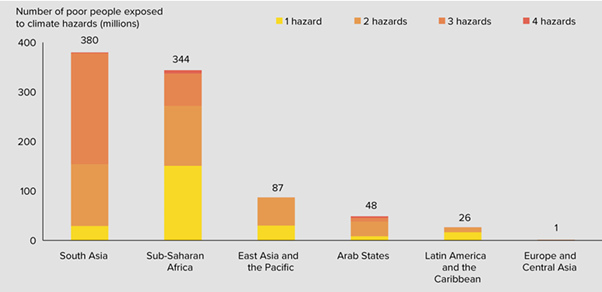
The combination of poverty and exposure to climate risks is one of the main factors of vulnerability in low-income countries. The United Nations Development Programme (UNDP) highlights that most people in multidimensional poverty are exposed to at least one climate risk, with millions facing multiple risks simultaneously (UNDP, 2025). Figure 1 shows that South Asia and Sub-Saharan Africa, regions that make up the Global South, have the highest number of poor people exposed to climate risks, totaling 724 million people. In addition, the overlap of risks (2, 3, or 4 risks) is significantly higher in these regions.
Graph 1: Number of Poor People Exposed to Climate Risks by Region (in millions)
Source: (adapted from UNDP, 2025, figure 5)
One of the most critical socioeconomic impacts of climate change, according to Rosenberg (2023), is the increased risk of food insecurity, especially in developing countries that are highly dependent on agriculture. Global warming, by raising temperatures and altering rainfall patterns, increases the risk of droughts, floods, and declines in agricultural production, directly affecting the livelihoods and economies of agricultural countries.
The UN defines poverty beyond monetary issues, encompassing lack of access to food and nutritional security, health, and education (Rosenberg, 2023). In this sense, climate change exacerbates poverty, as the destruction of the environment harms food production and hinders people’s access to essential resources for living. Given this scenario, climate finance emerges as an essential tool to mitigate impacts and promote adaptation, especially in the Global South. The goal is to strengthen countries so that they become more resilient to climate change, which includes financial support for changing the productive structure and implementing adaptation policies. Development finance institutions, such as BNDES and BDMG in Brazil, for example, are relevant actors in directing these resources, involving mitigation and adaptation to climate change (Tavares, 2023).
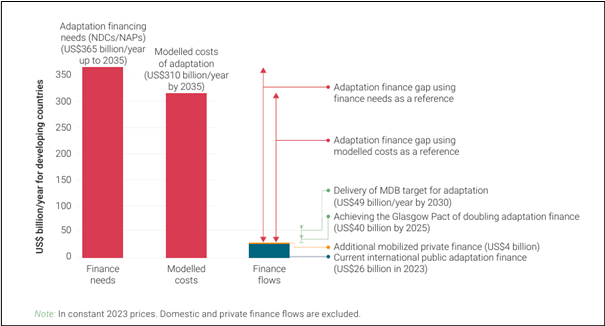
However, the effectiveness of this tool is compromised by the large gap between the financing needed and what is actually made available. The United Nations Environment Programme (UNEP), in its Adaptation Gap Report 2025, quantifies this disparity. According to Figure 2, the annual financing needs for adaptation in developing countries until 2035 are estimated at between US$310 and US$365 billion per year. In contrast, the current flow of international financing for adaptation is only US$26 billion. This funding gap, which is 12 to 14 times greater than the amount provided, demonstrates that the commitments made by developed countries fall short of what is needed to address the climate emergency in the Global South.
Graph 2: Comparison between Adaptation Financing Needs and Current Flows (in billions of US$)
Source: (UNEP, 2025, figure ES.3)
Given the lack of resources and the continuing cycle of vulnerability, some important questions arise: how long will countries in the Global South have to bear the consequences of inaction in the face of the climate crisis? Is it fair that the nations that have contributed least to the problem are the ones that suffer most from losses and damage that make it difficult to combat poverty?
The fight against poverty and the climate crisis are therefore two sides of the same coin. Achieving the sustainable development goals and eradicating poverty by 2030, as proposed by the Sustainable Development Goals (SDGs), depends on how the world collectively addresses the challenges that link social issues and the climate crisis.
References
BRUNA, Gilda Collet; PISANI, Maria Augusta Justi. Mudanças climáticas e pobreza: reflexões. Revista Brasileira de Ciências Ambientais, n. 18, 2010. Disponível em: https://www.researchgate.net/publication/393704115_Mudancas_climaticas_e_pobreza_reflexoes. Acesso: 03 nov. 2025.
Centre for Research on the Epidemiology of Disasters (CRED). 2025. 2024 Disasters in Numbers. Brussels, Belgium: CRED. Disponível em: https://files.emdat.be/reports/2024_EMDAT_report.pdf. Acesso: 06 nov. 2025.
Instituto de Pesquisa Econômica Aplicada (Ipea). ODS 1 – Erradicação da Pobreza. Disponível em: https://www.ipea.gov.br/ods/ods1.html. Acesso em: 07 nov. 2025.
ROSENBERG, Poly. O impacto das mudanças climáticas na pobreza e no risco de insegurança alimentar. Trabalho de Conclusão de Curso, Universidade Federal do Rio Grande do Sul, 2023. Disponível em: https://lume.ufrgs.br/handle/10183/258613. Acesso: 03 nov. 2025.
TAVARES, Sofia Serra. Mapeamento do financiamento climático no contexto dos bancos de desenvolvimento: um estudo de caso sobre as estratégias, construção de capacidades e monitoramento, reporte e verificação no BNDES e no BDMG. Dissertação de Mestrado, Fundação Getúlio Vargas, 2023. Disponível em: https://repositorio.fgv.br/server/api/core/bitstreams/7d3c9844-e3ac-4ac3-b675-c389aaf6d4da/content. Acesso: 03 nov. 2025.
UNEP (United Nations Environment Programme). Adaptation Gap Report 2025. Nairobi: UNEP, 2025. Disponível em: https://wedocs.unep.org/20.500.11822/48798. Acesso: 07 nov. 2025.
UNDP (United Nations Development Programme). 2025 Global Multidimensional Poverty Index (MPI): Overlapping Hardships: Poverty and Climate Hazards. Nova York: PNUD, 2025. Disponível em: https://hdr.undp.org/system/files/documents/global-report-document/mpireport2025en.pdf. Acesso: 07 nov. 2025.