By Tiago Conceição (CFC-GS/UFPA)
The Brazilian Amazon occupies a strategic position in the global debate on climate change, biodiversity, and sustainable development. In this context, climate finance has been presented as a central instrument for boosting the bioeconomy, understood as an economic model capable of reconciling environmental conservation, the valorization of traditional knowledge, and income generation from maintaining the forest standing.
According to Santos and Morais, “the bioeconomy has emerged as an economically sustainable and central approach to mitigating climate change and addressing the global challenges existing in the environmental policy landscape in the 21st century.” The bioeconomy can be understood as a development model based on the sustainable use of biodiversity and renewable biological resources, geared toward the integrated creation of economic, social, and environmental value. In the context of climate finance, the bioeconomy plays a strategic role in articulating ecosystem conservation, reducing greenhouse gas emissions, and strengthening climate adaptation, especially in territories of high socio-environmental vulnerability, such as the Brazilian Amazon.
From this perspective, bioeconomy initiatives such as socio-biodiversity chains, sustainable forest management, local bioindustries, and nature-based solutions are now eligible to receive climate finance resources. These investments seek to preserve forests, generate income for local populations, and create economic alternatives to deforestation. However, for these resources to have a real impact on the territories, it is essential that financing mechanisms are structured in a fair, participatory manner that is sensitive to local realities, valuing traditional knowledge and avoiding the commodification of biodiversity.
In this context, bio-jewelry produced by indigenous peoples and quilombola communities stands out as a concrete expression of the community-based bioeconomy. Made from seeds, fibers, and other natural materials collected in a sustainable manner, these bio-jewels combine income generation, environmental preservation, and cultural appreciation, reflecting ancestral practices of caring for nature. When supported by climate finance resources, these initiatives contribute to strengthening the economic autonomy of territories, protecting ecosystems, and recognizing indigenous peoples and quilombolas as protagonists in strategies to combat the climate crisis.
The debate on climate finance and the bioeconomy in the Brazilian Amazon shows that simply increasing financial resources is not enough to promote truly sustainable development. These investments must be aligned with principles of climate justice, participatory governance, and respect for territorial rights. Initiatives such as indigenous and quilombola bio-jewelry demonstrate that the bioeconomy can be a concrete alternative to deforestation, as long as it places local communities at the center of decision-making and recognizes their knowledge as fundamental to building lasting climate solutions. Thus, climate finance should be understood not only as an economic instrument, but as a political tool for social and environmental transformation in the Amazon.

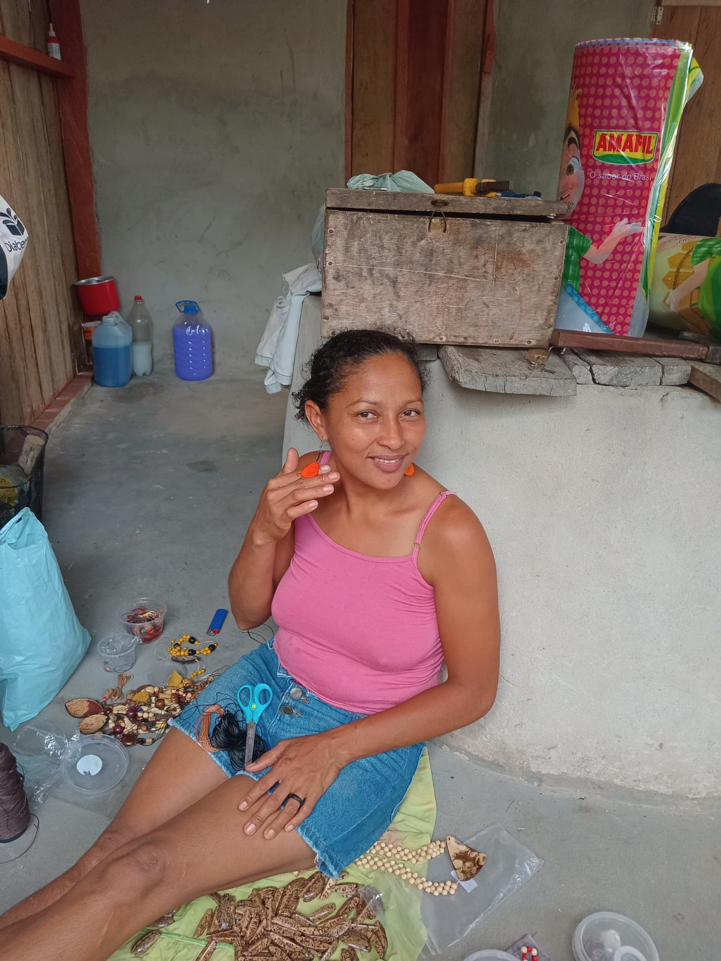

Source: Personal Archive
REFERENCES
VECCHIONE-GONÇALVES, Marcela. Financiando a Amazônia: do piloto de proteção nos anos 90 à bioeconomia descarbonizada do terceiro milênio. MIOLA, IZ; JUNQUEIRA, G. de O.; COUTINHO, DR, 2022. Available At: https://pdf.blucher.com.br/openaccess/9786555502480/04.pdf Acesso em: 02 fev. 2026.
TELLES, Nathália et al. Perspectivas para a bioeconomia como estratégia de desenvolvimento no Brasil: o papel da cooperação internacional. 2025.
SANTOS, Gleys Ially Ramos dos; MORAIS, Kamilla Vitoria Correia de. A JOGADA GEOPOLÍTICA SUSTENTÁVEL: Reposicionando o Brasil via Fundo Amazônia e Bioeconomia no governo Lula III. Revista Tocantinense de Geografia, [S. l.], v. 14,
n. 33, p. 288–312, 2025. DOI: 10.70860/rtg.v14i33.19832. Available At: https://periodicos.ufnt.edu.br/index.php/geografia/article/view/19832 Acessed: 01 fev. 2026.