By Andressa Lima (CFC-GS/UFPA)
International climate finance for developing countries continued to grow in 2024. According to the report Climate Finance Provided and Mobilised by Developed Countries in 2013-2024, published in 2026 by the Organisation for Economic Co-operation and Development (OECD), developed countries provided and mobilised USD 136.7 billion for climate action in developing countries in the latest year covered by the analysis.
The report is part of the Climate Finance and the USD 100 Billion Goal series and continues the monitoring carried out by the OECD since 2015, at the request of donor countries, on progress towards the commitment established under the United Nations Framework Convention on Climate Change (UNFCCC). Under this commitment, developed countries were expected to collectively mobilise USD 100 billion per year to support climate action in developing countries, in the context of meaningful mitigation action and transparency on implementation. The goal was originally intended to be reached by 2020 and was subsequently extended through 2025.
The 2026 edition adds data for 2023 and 2024 to the historical series, making it possible to examine not only changes in the total volume of finance, but also its composition, the financial instruments used, the distribution between mitigation and adaptation, the mobilisation of private finance, and the profile of recipient countries.
It is important to consider the scope of these figures. The OECD itself emphasises that they do not represent all finance for climate action in developing countries. The methodology covers four components: bilateral public climate finance; multilateral public climate finance attributable to developed countries; climate-related officially supported export credits; and private finance mobilised by public interventions. It does not include, for example, developing countries’ domestic public climate finance or private investment undertaken without an associated public intervention.
Climate finance in 2023 and 2024
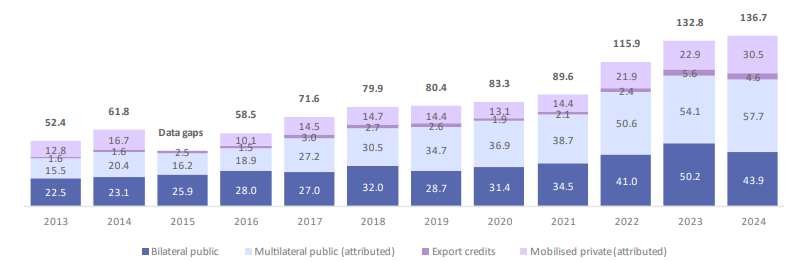
One of the main findings of the report is that climate finance remained above the annual USD 100 billion goal. After reaching USD 115.9 billion in 2022, the first year in which the commitment was met, the total increased to USD 132.8 billion in 2023 and reached USD 136.7 billion in 2024.
The trajectory is significant when viewed over the period covered by the report. In 2013, the first year of the OECD series, recorded climate finance amounted to USD 52.4 billion. By 2021, it had reached USD 89.6 billion. From 2022 onwards, annual volumes exceeded USD 100 billion, although the goal was achieved two years after its original target date.
Figure 1. Climate finance provided and mobilised in 2013-2024 (USD billion).
Source: OECD (2026), based on Biennial Reports to the UNFCCC, OECD DAC and Export Credit Group statistics, and complementary reporting to the OECD.
The composition of climate finance
Figure 1 also illustrates the composition of these resources. Bilateral and multilateral public climate finance continued to account for approximately three-quarters of the total in 2023 and 2024.
In 2024, multilateral public climate finance attributable to developed countries reached USD 57.7 billion, up from USD 54.1 billion in 2023. Bilateral public climate finance, meanwhile, declined from USD 50.2 billion in 2023 to USD 43.9 billion in 2024.
Combined, bilateral and multilateral public flows amounted to USD 101.6 billion in 2024, slightly below the USD 104.3 billion recorded in 2023. Climate-related officially supported export credits, which represent a smaller share of the total, decreased from USD 5.6 billion to USD 4.6 billion.
Thus, although total climate finance increased between 2023 and 2024, this growth was not evenly distributed across its different components.
Growth in mobilised private finance
One of the main changes between 2023 and 2024 concerned private finance mobilised by public interventions. The amount increased from USD 22.9 billion to USD 30.5 billion, representing growth of approximately 33% and the largest annual increase in this component since the beginning of the comparable series in 2016.
Multilateral development banks played an important role in this increase. Private finance mobilised by these institutions and attributed to developed countries rose from USD 14.3 billion in 2023 to USD 17.4 billion in 2024. For multilateral climate funds, the amount more than doubled between the two years, reaching USD 4.5 billion.
The report also draws attention to the concentration of mobilised private finance in a relatively small number of large transactions. The 20 largest projects in 2023 and 2024 accounted for close to one-quarter of private climate finance mobilised in those years. Aggregate figures can therefore be significantly affected by the timing and scale of large transactions.
The distribution across country income groups is also uneven. Between 2016 and 2024, 66% of mobilised private finance was concentrated in middle-income countries, while low-income countries accounted for only 3%.
The evolution of adaptation finance
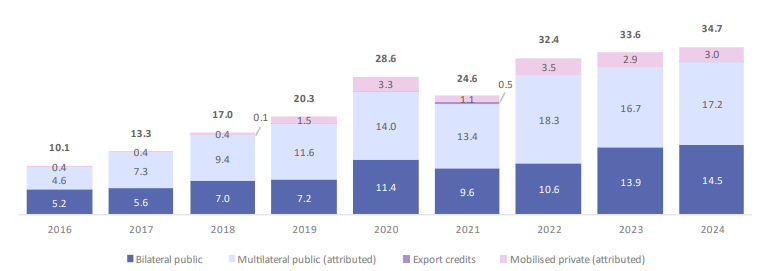
Finance for adaptation reached USD 33.6 billion in 2023 and USD 34.7 billion in 2024. Despite growth over the historical series, the recent increase was relatively modest, at approximately USD 1 billion per year between 2022 and 2024.
More than 90% of adaptation finance in 2023 and 2024 continued to come from public sources. Mobilised private finance for adaptation stood at approximately USD 3 billion in both years.
Figure 2. Adaptation finance provided and mobilised in 2016-2024 per component (USD billion).
Source: OECD (2026), based on Biennial Reports to the UNFCCC, OECD DAC and Export Credit Group statistics, and complementary reporting to the OECD.
These figures are particularly relevant in light of the Glasgow Climate Pact’s call for developed countries to at least double their collective provision of adaptation finance by 2025 compared with 2019 levels. Using the public finance figures tracked by the OECD as the baseline, an additional increase of USD 5.8 billion, or 18%, would be required in 2025 to achieve this doubling.
In terms of the overall thematic composition, adaptation accounted for approximately 25% of climate finance in both 2023 and 2024. Mitigation continued to represent the largest share, reaching USD 87.3 billion in 2023 and USD 86.9 billion in 2024. Cross-cutting activities addressing both mitigation and adaptation increased from USD 11.9 billion to USD 15.1 billion.
Public climate finance instruments
Loans remain the main instrument used to provide public climate finance. In 2023, they accounted for 73% of the total, or USD 75.6 billion. In 2024, their share decreased to 67%, equivalent to USD 68.5 billion.
Grants, in turn, increased their share. They rose from 24% of public climate finance in 2023, or USD 24.8 billion, to 29% in 2024, or USD 29.7 billion. Equity investments remained comparatively small, accounting for 3% of the total in 2024.
The mix of financial instruments varies significantly according to recipient countries’ income levels. Between 2016 and 2024, loans accounted for 92% of public climate finance provided to high-income countries included in the analysis, 87% in upper-middle-income countries, and 85% in lower-middle-income countries.
In low-income countries, the composition was different: approximately 65% of public climate finance was provided in the form of grants. The report associates this pattern with these countries’ specific needs, including the greater importance of adaptation and their more constrained capacity to access and repay debt.
The distribution of finance across developing countries
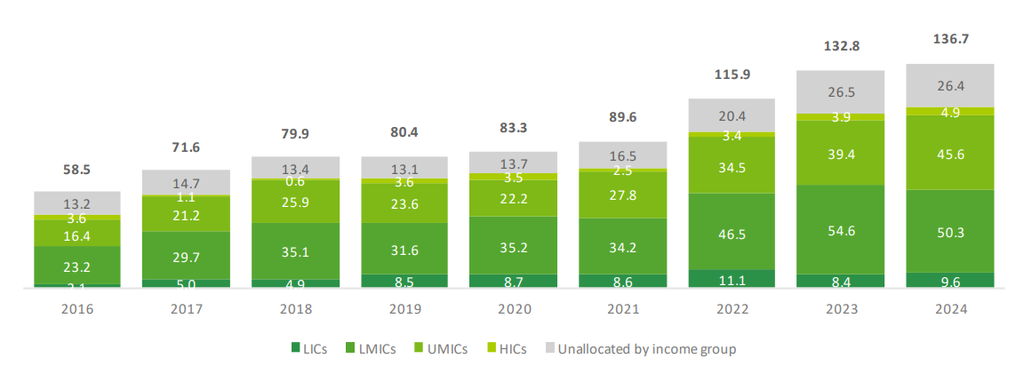
Middle-income countries continue to receive the largest share of climate finance tracked by the OECD. In 2023 and 2024, lower-middle-income countries were the main beneficiaries, receiving an average of 39% of the total, equivalent to approximately USD 52.5 billion per year.
Upper-middle-income countries received around 32%, while low-income countries accounted for 7% of climate finance in 2023-2024. In absolute terms, however, finance for low-income countries reached USD 9.6 billion, approximately four times the amount recorded in 2016.
There are also regional differences. Between 2016 and 2024, Asia received 39% of the climate finance tracked. Its share declined from 46% in 2016 to 36% in 2024. Africa’s share, by contrast, increased from 24% to 31% over the same period.
Figure 11. Climate finance provided and mobilised in 2016-2024 per developing country income group (USD billion).
Source: OECD (2026), based on Biennial Reports to the UNFCCC, OECD DAC and Export Credit Group statistics, and complementary reporting to the OECD.
Climate finance for LDCs and SIDS
The report pays particular attention to Least Developed Countries (LDCs) and Small Island Developing States (SIDS). In both groups, adaptation represented a larger share of climate finance than it did across developing countries as a whole.
Between 2016 and 2024, adaptation accounted for 46% of climate finance provided and mobilised for LDCs and SIDS, compared with approximately one-quarter for all developing countries.
Public finance also plays a more significant role in these countries. It represented 89% of total climate finance in SIDS and 86% in LDCs, compared with 78% across all developing countries. Grants accounted for half of public finance provided to SIDS and 45% of public finance provided to LDCs.
The share of mobilised private finance was comparatively lower: 7% in LDCs and 10% in SIDS, compared with 18% across developing countries as a whole.
The transition to the new climate finance goal
The 2023 and 2024 data confirm that climate finance provided and mobilised by developed countries remained above the previous annual USD 100 billion goal. At the same time, the composition of these resources reveals important differences across countries, instruments, and climate objectives: mitigation remains predominant, loans account for the largest share of public climate finance, and private finance mobilisation is concentrated primarily in middle-income countries.
These findings also help contextualise the next stage of the international climate finance agenda. At COP29 in 2024, Parties to the UNFCCC adopted the New Collective Quantified Goal on Climate Finance (NCQG) for the 2026-2035 period. The decision established a goal of at least USD 300 billion per year by 2035, with developed countries taking the lead, within a broader effort to scale up climate finance from all sources to at least USD 1.3 trillion annually by 2035.
In this new context, the data compiled by the OECD make it possible to examine not only changes in the overall volume of international climate finance, but also how these resources are provided and mobilised, which financial instruments are used, and how finance is distributed across different groups of countries and climate objectives. These dimensions will be important for monitoring the scaling-up of climate finance in the years ahead.
Reference
OECD. Climate Finance Provided and Mobilised by Developed Countries in 2013-2024. Climate Finance and the USD 100 Billion Goal. Paris: OECD Publishing, 2026. Available at: OECD – Climate Finance Provided and Mobilised by Developed Countries in 2013-2024. DOI: 10.1787/ab5eb9ad-en.