By Alcilene Farias (CFC-GS/UFPA)
Sustainable project financing, energy transition, and green finance are terms that have become increasingly common in public and academic debate in the face of global environmental and economic challenges. However, despite the growing centrality of these concepts, it is still pertinent to question how these processes materialize in practice. Where are the resources allocated to these objectives directed? How are they applied, who manages them, and what effective results have been produced from these investments?
In this context, tracking climate finance becomes particularly relevant, since in many cases there is no clarity about the destination of the resources mobilized for this purpose or how they are being effectively used. The observation and organization of information on financed projects, therefore, constitute an important tool for better understanding the allocation of these resources and their possible results and impacts. In this text, the project examined is the Financing Program for Sustainable Energy (BR-L1442), the first operation of the CCLIP BR-O0001 program.
What is the Financing Program for Sustainable Energy and how is it structured?
The project identified by the Inter-American Development Bank (IDB) as BR-L1442 is an initiative aimed at expanding access to medium- and long-term financing for productive and sustainable investments in Brazil (IDB, 2016). The main objective of the initiative is to encourage companies to expand their investments in strategic areas of the economy. According to IDB institutional reports, the program’s resources were allocated to support unconventional renewable energy and energy efficiency projects.
The Financing Program for Sustainable Energy is not an isolated project. It is part of a larger program structured by the IDB through the Conditional Credit Line for Investment Projects (CCLIP) mechanism, used by the bank to support long-term investment programs. Thus, instead of financing only one isolated project, the bank establishes a credit line that allows for the approval of different operations over time.
In the case analyzed, the program has a total financing limit of US$ 2.4 billion, while the first operation (BR-L1442) provides for a US$ 750 million loan from the IDB, with a total amount of US$ 900 million, including US$ 150 million contributed by the BNDES (Brazil, 2018). The project was approved in December 2016, with implementation beginning in 2017, when the first disbursements were made.
How does the financing mechanism work?
Financing is provided by the IDB and executed through the BNDES, which acts as a financial intermediary responsible for selecting the subprojects that will receive investment. Thus, the IDB grants a loan to the BNDES within the CCLIP program structure. The BNDES then uses these funds to offer credit to companies interested in investing in sustainable energy projects.
One of the main indicators of success for financial programs is the level of execution of resources. According to institutional assessments by the IDB, the BR-L1442 project had US$ 750 million approved, with the funds being fully disbursed and used to support BNDES credit lines for private renewable energy and energy efficiency projects. Figure 1 shows the program’s cash flow statement, indicating the funds received from the IDB and the local counterpart. The total for the first operation amounts to US$ 900 million, with US$ 750 million coming from the IDB and US$ 150 million from the BNDES.
Figure 1 – Cash flow statement
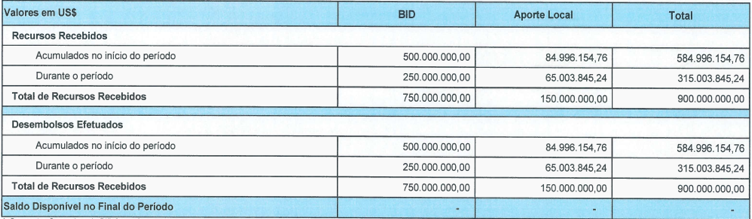
Source: BRASIL. Controladoria-Geral da União. Projeto 3866/OC-BR: Inter-American Development Bank (IDB). Rio de Janeiro, 2018, p. 5.
Observed impacts
According to the Project Completion Report (PCR) prepared by the IDB, the observed impacts should be interpreted mainly at the financial and institutional level, rather than as direct impacts on infrastructure or specific energy generation. This is because the operation was structured as a credit line brokered by the BNDES, which was responsible for selecting and financing eligible subprojects with the loan funds. Thus, the effects of the project are mainly related to expanding the capacity to finance sustainable investments in the country and strengthening medium- and long-term credit mechanisms for the energy sector (IDB, 2019).
However, the report also notes limitations in the implementation of some of the planned indicators. Although the program’s funds were fully disbursed, one of the indicators related to energy efficiency projects did not show significant progress, largely due to low demand for this type of financing during the program’s implementation period. As a result, some of the objectives originally defined for this dimension of the program were not fully achieved (IDB, 2019).
Based on these results, the completion report classifies the overall performance of the operation as “partly successful.” The assessment indicates that the project contributed to expanding sustainable energy financing and supporting investments in renewable energy in Brazil, but some specific results, mainly related to energy efficiency, were not fully achieved (IDB, 2019).
REFERENCES
INTER-AMERICAN DEVELOPMENT BANK (IDB). Financing Program for Sustainable Energy (BR-L1442). Washington, D.C., 2016.Disponível em: https://www.iadb.org/en/project/BR-L1442. Acesso em: 6 mar. 2026.
INTER-AMERICAN DEVELOPMENT BANK (IDB). Loan Proposal: Financing Program for Sustainable Energy (BR-L1442). Washington, D.C., 2016. Disponível em: https://ewsdata.rightsindevelopment.org/projects/IADB-BR-L1442/pdf/. Acesso em: 6 mar. 2026.
BRASIL. Controladoria-Geral da União. Secretaria Federal de Controle Interno.Relatório financeiro do Projeto 3866/OC-BR – Inter-American Development Bank (IDB). Rio de Janeiro: CGU, 2018. Disponível em: https://www.iadb.org/document.cfm?id=EZSHARE-1086647181-12. Acesso em: 7 mar. 2026.
INTER-AMERICAN DEVELOPMENT BANK (IDB). Project Completion Report: Financing Program for Sustainable Energy (BR-L1442). Washington, D.C.: IDB, 2019. Disponível em: https://www.iadb.org/document.cfm?id=EZSHARE-1096337262-40. Acesso em: 7 mar. 2026.