
By Alcilene Farias (CFC-GS/UFPA)
What is the Climate Fund?
The National Fund on Climate Change, established by Law No. 12,114/2009, is a public policy instrument designed to finance actions related to climate change mitigation and adaptation in Brazil. Linked to the Ministry of the Environment, the fund was designed to support initiatives that contribute to reducing greenhouse gas emissions and increasing climate resilience (Brazil, 2026). Thus, it operates as a public financial instrument, whose central function is to direct resources to strategic sectors of the climate transition. It operates by financing projects, programs, and studies, covering both productive investments and institutional actions.
In this sense, the role of the Climate Fund goes beyond the implementation of environmental policies, as the initiative involves allocating public resources to activities with climate impact and connects environmental policy to economic financing. Its operations are divided into two categories: repayable and non-repayable. The repayable category is managed by the Brazilian Development Bank (BNDES) and consists of granting credit to finance projects with an economic return. Here, funds are primarily directed toward investments in sectors such as renewable energy, energy efficiency, sustainable mobility, and infrastructure, and are subsequently repaid to the fund by the beneficiaries, allowing them to be reused for new financing (BNDES, 2026).
The non-reimbursable modality, on the other hand, is geared toward financing projects that do not generate a direct financial return. Non-reimbursable funds are allocated directly by the Ministry of the Environment or through agreements and partnerships with local governments and civil society organizations. In 2025, climate adaptation projects were supported in vulnerable urban areas, with a focus on nature-based solutions, community capacity building, and territorial planning (Brazil, 2025).
Chart 1 – Climate Change Mitigation and Adaptation
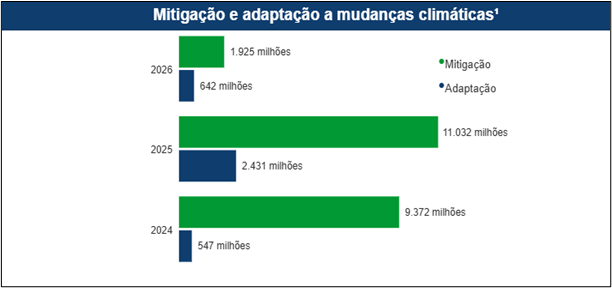
¹The data follows the BNDES’s sustainable taxonomy, which will be adopted starting in 2024. According to the bank, some transactions may appear in more than one category, so the sum of the categories does not equal the total amount of the Climate Fund (BNDES, 2026).
Source: BNDES. Climate Fund Dashboard (2026).
According to the classification adopted by the BNDES, in 2025 mitigation projects accounted for 11.032 billion reais allocated to initiatives aimed at reducing greenhouse gas emissions, while 2.431 billion reais were directed toward climate adaptation projects. This pattern highlights the centrality of investments linked to the energy transition, sustainable mobility, and low-carbon technologies in the fund’s recent activities (BNDES, 2026).
The fund’s role in climate finance
The fund’s contribution is important because it helps direct resources toward strategic sectors of the economy, such as clean energy, sustainable infrastructure, and innovation. In this way, it influences capital allocation in the country and encourages changes in development patterns.
Thus, it is not limited to financing isolated projects but helps guide investment toward activities compatible with the transition to a low-carbon economy. Another relevant aspect is its role in complementing private financing, since the private sector tends to avoid projects with greater uncertainty or long-term returns. In this context, the Climate Fund acts to reduce risks and enhance the viability of these investments, which is particularly important in developing countries, where there are limitations on access to international climate finance and a need to mobilize domestic resources (Daudt; Souza; Marques, 2024).
Coordination among different institutional actors is also important, given that this framework involves the federal government, development banks such as the BNDES, and oversight bodies, which allows for the alignment of public policy guidelines with the financial implementation of projects. This coordination therefore contributes to greater coordination of climate actions in the country and to the integration of environmental and economic policies. Given the increasing investment needs to address climate change, financial instruments such as this one become central to sustaining the necessary volume of resources and ensuring the continuity of financing over time.
In light of the above, the Climate Fund plays a significant role in Brazilian climate finance by directing public resources to strategic sectors and enabling investments that require specific financing conditions. Its activities contribute to expanding financing capacity and supporting the transition to a low-carbon economy. However, its impact depends on the expansion of resources, the continuity of policies, and coordination with other sources of financing. Thus, the fund should be understood as part of a broader arrangement, in which different instruments act in a complementary manner to sustain climate finance in the country.
You can read more articles about climate finance on our blog and access financing data on our tracker. Check it out!
REFERENCES
BRASIL. Lei nº 12.114, de 9 de dezembro de 2009. Cria o Fundo Nacional sobre Mudança do Clima. Diário Oficial da União: Brasília, DF, 2009. Disponível em: https://www2.camara.leg.br/legin/fed/lei/2009/lei-12114-9-dezembro-2009-596941-normaatualizada-pl.pdf . Acesso em: 4 maio 2026.
BRASIL. Ministério do Meio Ambiente. Fundo Nacional sobre Mudança do Clima. Disponível em: https://www.gov.br/mma/pt-br/composicao/secex/dfre/fundo-nacional-sobre-mudanca-do-clima. Acesso em: 4 maio 2026.
BRASIL. Ministério do Meio Ambiente e Mudança do Clima. Relatório de execução do Fundo Nacional sobre Mudança do Clima (FNMC) – 2025. Brasília, 2025. Disponível em: https://www.gov.br/mma/pt-br/composicao/secex/dfre/fundo-nacional-sobre-mudanca-do-clima/Relatorio_FNMC_MMA_2025_Final.pdf. Acesso em: 4 maio 2026.
BANCO NACIONAL DE DESENVOLVIMENTO ECONÔMICO E SOCIAL (BNDES). Fundo Nacional sobre Mudança do Clima (FNMC).
Disponível em: https://www.bndes.gov.br/wps/portal/site/home/financiamento/produto/fundo-clima. Acesso em: 5 maio 2026.
BANCO NACIONAL DE DESENVOLVIMENTO ECONÔMICO E SOCIAL (BNDES). Relatório de execução do Fundo Nacional sobre Mudança do Clima – FNMC 2025. Rio de Janeiro: BNDES, 2025. Disponível em: https://web.bndes.gov.br/bib/jspui/bitstream/1408/29427/1/PRPer_216234_FNMC_relat%c3%b3rio%20de%20execu%c3%a7%c3%a3o_2025.pdf. Acesso em: 5 maio 2026.
DAUDT, Gabriel Marino; SOUZA, Luiz Daniel Willcox de; MARQUES, Felipe Silveira. O novo Fundo Clima: potencializando o papel do BNDES no combate à emergência climática. Revista do BNDES, Rio de Janeiro, v. 30, n. 60, p. 159-208, dez. 2024. Disponível em: https://web.bndes.gov.br/bib/jspui/bitstream/1408/27787/1/PRArt_216523_O%20novo%20Fundo%20Clima.pdf. Acesso em: 4 maio 2026.