By Andressa Lima (CFC-GS/UFPA)
The expansion of Line 5 (Lilac) of the São Paulo Subway is an urban transport infrastructure project aimed at expanding the subway network and improving mobility in the São Paulo Metropolitan Region. Line 5 was originally inaugurated in 2002, operating between Capão Redondo and Largo Treze, still disconnected from the rest of the system. The expansion project aimed to fully integrate the line into the city’s subway-rail network, expanding its connectivity and service capacity.
Figure 1: SPMR subway network.
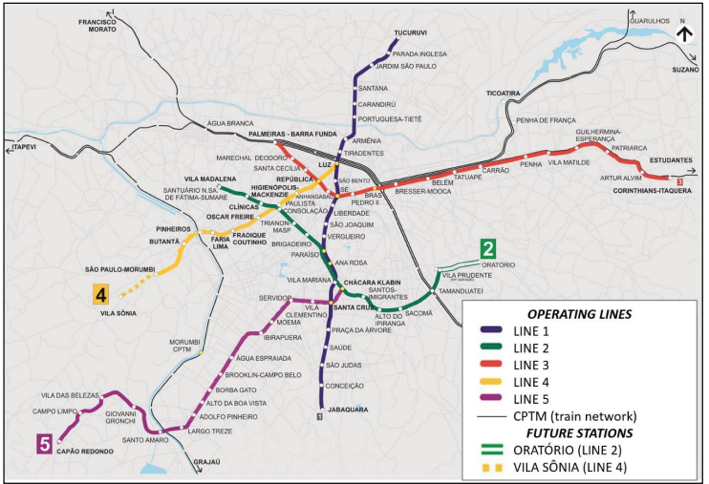
Source: World Bank (2021)
The project included civil works, tunnel excavation, installation of electrical, telecommunications, control, and signaling systems, as well as the acquisition of 26 new trains. The implementation was structured in two phases: the first, between Adolfo Pinheiro and Água Espraiada, with four stations and more than 1,200 meters of tunnels, scheduled for completion in 2010; and the second, between Água Espraiada and Chácara Klabin, with six new stations, scheduled to start operating in 2012. In the end, all stations on the extension were operational. The project sought to generate structural changes in urban mobility patterns, expanding the supply of high-capacity public transportation, reducing travel times, and definitively integrating Line 5 with the other lines of the subway-rail system, as illustrated in Figure 2.
Figure 2: Diagram of the extension of Line 5
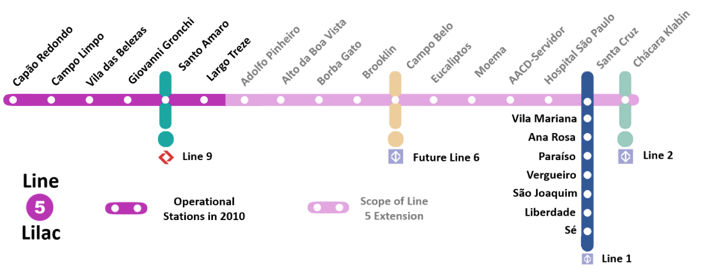
*Note: The new stations on the Line 5 extension are shown in a lighter color. The figure also shows a segment of Line 1 to the Sé central subway station, instead of the 23 complete stations.
Source: World Bank (2021).
From a financial standpoint, the total cost was originally estimated at US$2.516 billion, but the revised and executed amount reached US$3.781 billion. The financing combined multilateral resources and domestic contributions. The World Bank disbursed US$650.4 million. The Inter-American Development Bank initially approved US$ 480.97 million, but disbursed approximately US$ 367.1 million after revision. The largest share came from the State of São Paulo itself, whose contribution was increased to US$ 2.763 billion. In the end, the total executed amounted to US$ 3.781 billion.
Within the scope of the CFC-GS, the data used to identify the project was extracted from the OECD database, which gathers financial commitments reported by multilateral institutions and classifies them according to climate relevance markers. The CFC-GS organizes this information to structure its own climate finance database and monitor projects with components related to mitigation or adaptation.
In the OECD database, the project appears as an operation approved in 2010, financed by the Inter-American Development Bank through a debt instrument with ordinary capital resources, without concessional terms. The sector is classified as Transportation and Storage, specifically Rail Transportation, and Brazil is identified as an upper-middle-income country. The amount recorded in the database is US$ 480,958,000, classified as “climate components.” This amount corresponds to the commitment originally reported with a climate marker and does not represent the total cost of the project or necessarily the amount actually disbursed. As the final budget reached US$ 3.781 billion and came from multiple sources, the portion identified by the CFC-GS corresponds to only a fraction of the total investment.
In terms of climate finance, the project is classified as a mitigation initiative in the urban transport sector. The climate rationale lies in the expansion of high-capacity electric rail transport, which tends to replace travel by cars and buses, which are more emission-intensive modes of transport. According to the World Bank’s final report (2021), the operation of the expanded Line 5 results in an estimated average annual reduction of approximately 122,000 tons of CO₂ equivalent, due to the replacement of trips made by cars and buses with subway trips, which are less carbon intensive.
This estimate results from a comparison between a scenario with the expanded Line 5 in operation and a counterfactual scenario in which users would continue to predominantly use cars and buses. Projecting this annual savings over the useful life of the assets, estimated at around 50 years, the cumulative reduction reaches approximately 2.96 million tons of CO₂ equivalent. The report also assigns economic value to these avoided emissions based on the social cost of carbon, estimating benefits of around US$ 75.6 million over the period, which reinforces the environmental and economic dimension of the project.
In terms of mobility, the project achieved significant reductions in travel time. The journey between Largo Treze and Chácara Klabin was reduced from 72 to 26 minutes, and between Capão Redondo and Sé it fell from 99 to 50 minutes. The integration of Line 5 with other key lines in the network has expanded the system’s reach, facilitating access to central areas and different regions of the city with fewer transfers and greater predictability of travel. The benefits have been particularly relevant for low-income populations in the line’s area of influence, expanding access to jobs, public services, and urban opportunities.
For CFC-GS, the case of Line 5 of the São Paulo subway illustrates both the transformative potential of climate finance in urban infrastructure and the challenges of measurement and attribution. The international database records commitments classified as climate-related, but does not automatically capture budget revisions, actual disbursements, or the relative share of these resources in the total project cost. Assessing the effectiveness of climate finance therefore requires going beyond the reported figures and analyzing its real role in enabling investments and generating measurable impacts on mitigation and sustainable mobility.
References
WORLD BANK. Sao Paulo Metro Line 5 Project (P116170): Implementation Completion and Results Report. Washington, DC: World Bank, 2021.